Working towards your vision
Evidence-based, personalized care for active adults. OHIP-covered visits.
Clinician assessment
Sports Pharmacist consult
Share your data
Personalized biomarkers
Your trainer
What we treat
Select your focus
* All three are done in person. DEXA at an independent testing facility, VO2 max there or at select partner gyms, and grip strength at select partner gyms.
How it works
Running on repeat
No referral required.
01
Qualify
A simple questionnaire to confirm your eligibility.
02
Intake
Medical and social history, your medications and supplements, and your vision.
03
Share your data
Wearable data, bloodwork, training load. Up to 689 structured data points, so they can be compared over time.
04
We prepare before you are seen
Your data runs against 419 written rules, and whatever they flag goes in front of your clinician. The rules never decide anything; they only put it on the desk.
05
See your clinician
By video or phone, covered by OHIP.
06
Pharmacist review
Every prescription is checked before it is dispensed, by a Sports Pharmacist registered with the Ontario College of Pharmacists.
07
Prescription
Pick up from the pharmacy of your choice.
08
Trainer loop
With your written consent, your trainer sees your training and body composition — never your medical record.
09
Recheck
New data comes in, the rules run again, and the plan adjusts.
Different by design
What sits behind step four, and who signs off on it.
689
data points
419
rules
102
sources
Accountability
Who’s in the loop
Care is delivered by Trean Clinical Services Inc., a licensed practice led by a Medical Director, under CPSO and OCP standards.
Personalized
Governance
Physician
Safety
Sports Pharmacist
Accountability
Your Trainer
Privacy
PHIPA compliant
Check your eligibility
Answer a few quick questions to see if Trean is the place for you.
Different by design
OHIP-covered visits with a Trean physician, and a pharmacist review of every prescription. Ontario only.
Expertise
Two licensed clinicians, on every case
Physician
Registered with the College of Physicians and Surgeons of OntarioSports Pharmacist
Registered with the Ontario College of Pharmacists · practice focus, active adultsCollaboration
And we collaborate with your trainer
They see you twice a week. We see you a few times a year.
01
What they see
Your training and body composition, only with your written consent. Never your medical record, and you can change your mind any time.
02
They coach. We prescribe.
Trainers are not clinicians and do not recommend or prescribe medication.
What sits underneath
We built the parts you cannot see
689
data points we can hold about you, structured so they compare over time
419
written rules in 199 families, reviewed and updated every quarter
102
catalogued sources in the evidence library behind those rules
48
structured questionnaires and templates, so nothing gets asked twice
As of October 2026. Reviewed quarterly, so these numbers move.
Clinician in the loop
The engine runs. A person decides.
Those rules run against your data before your visit and put whatever they flag in front of your clinician.
01
It makes no clinical decisions
It cannot diagnose, prescribe, set a dose, or change your plan.
02
A clinician signs off
Nothing reaches you until a clinician has read it and signed it.
03
You can ask why
Ask, and they can show you the rule behind it.
Personalized
Which is why no two plans look the same
Your plan is built from your bloodwork, your body composition, your training, your medications and supplements, and your medical and social history — not from a template with your name at the top.
Cost
And most of it costs nothing
OHIP covered
$0
Appointments with a Trean physician, and blood work where it is medically necessary, are covered by OHIP.
Optional program
One
One optional program carries a fee, listed on our pricing page. Nothing else we do has one.
See it for yourself
The eligibility check takes two minutes. No referral needed.
Trean cares for patients located in Ontario; care is provided by Trean Clinical Services Inc., an independent licensed practice. General information rather than medical advice — not for emergencies, call 911 or go to your nearest emergency department. trean.ca
Care that keeps up
with your training
Help me decide
Answer a few questions and we'll point you to the right program — or tell you if Trean isn't the right fit.
Personalized biomarkers
How it works
Measured metrics, not guess work
01
We decide together what is important
02
Bloodwork is drawn
03
Your clinician reviews them with you
04
A plan is set
05
Your trainer is brought in
06
You train, and we watch the markers
07
Bloodwork is repeated
08
The plan adjusts, and the loop runs again
The question nobody asks
When did you last train hard?
Ferritin
Rises after exercise
CRP
Inflammation climbs
Creatine kinase
Stays raised a week
Hemoglobin
Looks low in endurance
Laboratory testing may be covered by OHIP where it is medically necessary. Please discuss with your clinician.
Know your numbers
The panels
Panel options
Comprehensive assessments
Healthy Living Assessment
Enhanced Healthy Living Assessment
Longevity Panel
Targeted panels
Cardiovascular Panel
Metabolic Panel
Lipids Panel
Fatigue Panel
Iron Panel
Hematology Panel
Inflammation Panel
Liver / Digestion Plus Assessment
IV Panel
Methylation Panel
Autoimmune Panel
Hormone and thyroid
Basic Hormone Panel
Enhanced Hormone Panel
Men's Health Panel
Female Fertility Panel
Basic Thyroid Assessment
Enhanced Thyroid Assessment
Thyroid Follow-Up Assessment
Nutrients and minerals
Nutrient Panel
Vitamin Panel
Mineral Panel
Laboratory testing may be covered by OHIP where it is medically necessary. Please discuss with your clinician.
Measured, not guessed
We refer you out for physiological testing. You book with the facility and pay them directly.
Where you go
Where we send you for testing

Most people training hard are working from estimates: a bathroom scale, a watch, a calculator that guessed their calories from their height. Measured properly, all three of those become real numbers. We do not run a testing facility ourselves, so we send you to BodyStats in Toronto.
A DEXA scan shows how much of you is muscle, fat and bone, and where each sits, which a scale cannot tell you. A VO2 max test shows how well your body uses oxygen when you are working hard, the measure most endurance training is built around. An RMR test measures what you actually burn at rest rather than estimating it from a formula, which matters most when you are trying to change your weight. About an hour covers all three, and your clinician reads them against your bloodwork and your training.
By referral
VO2 max
How much oxygen you can actually use. $74.99 + HST at the facility.
By referral
Resting metabolic rate
What you burn at rest, measured rather than estimated. $74.99 + HST.
By referral
DEXA body composition
Fat, lean mass and bone, by region. $39.99 + HST.
All three
One visit
The three together in about an hour. $159.99 + HST.
Either route works. Booking with them directly is quickest. If you would rather your clinician set it up, or you are not sure which tests you need, book with us and we will sort it out with you. Grip strength is measured in person at select partner gyms, at no charge.
If you are using,
we would rather know
We do not prescribe, supply or endorse peptides. If you are already using, a clinician can help you do it more safely.
The approach
No lectures
You do not have to stop to be seen, and nobody here will talk down to you for being honest. This is harm reduction: if something is happening anyway, the useful question is how to make it less dangerous.
What we do
Five things, none of them supply
01
Education
What is actually known about what you are taking, and what is not.
02
Counselling
What you are hoping for, and whether there is a safer route to it.
03
Safer injection practice
Technique, rotating sites, sterile supplies and sharps disposal.
04
Monitoring
Symptoms and side effects tracked over time, so a change gets noticed early.
05
Blood work if it is indicated
Ordered when the result would change something, not as a routine panel.
What we do not do
We are not a supplier
No supply
We do not prescribe, supply or endorse peptides
We do not source them, point you at a seller, or tell you a dose.
No endorsement
Nothing here says you should use them
Many are not approved by Health Canada and are used off-label.
No judgement
Not using is not a condition of care
We will be straight with you about the risk, and you are still welcome.
Worth saying out loud
Tell us everything you are taking
Including anything you bought yourself or are not sure about. Bring the vial, the label, or a photo of it.
Chest pain, trouble breathing, a spreading or hot injection site, or a fever is urgent. Call 911 or go to your nearest emergency department.
Common questions
The questions people ask
Will you refuse to see me if I keep using?
No. You do not have to stop to be seen.
Do I need someone already prescribing for me?
No. If another clinician is overseeing your therapy we work alongside them, and if nobody is, we will still see you.
Will you prescribe me something instead?
A clinician decides that at an assessment, and sometimes the answer is none. Either way we will not supply or source a peptide.
What does it cost?
The visit is covered by OHIP, and so is blood work where it is medically necessary. Anything uninsured is billed by the lab directly, not by us.
What if I do not know what I am taking?
Still worth the appointment. Bring whatever you have, including the packaging.
Start with the eligibility check
Two minutes, no referral. You will not be asked to stop anything to book.
Trean cares for patients located in Ontario; care is provided by Trean Clinical Services Inc., an independent licensed practice. We do not prescribe, supply or endorse peptides, nothing here is a recommendation to use any substance, and this is general information rather than medical advice — not for emergencies, call 911.
Most of what we do is at no cost
Every appointment with a Trean physician is covered by OHIP. One program has a fee.
Who charges what
Three places a bill can come from
OHIP covered
$0
Appointments, prescriptions, and bloodwork when it is needed.
OHIP covered visits
$0
- Weight management
- Peptide monitoring
- Fatigue or poor recovery
- Sexual health (ED)
- Low libido (TRT)
- Blood work request
- Medication or supplement review
- Low libido, women
- Menopausal symptoms
- Contraception
- Menstrual cycle concerns
- Acne
- STI testing
- Hair loss
- Anything else
The testing facility charges
~$160
+ HST
VO2 max, RMR and DEXA body composition. We refer you out. You book and pay them directly, at their price.
Optional program
$499–899
Only for the optional Comprehensive Exercise Science program. Parts of this program may be claimable through a Health Spending Account. We provide itemised receipts — check with your plan administrator.
Medication is dispensed and billed by the pharmacy you choose. We take no commission on it, and no margin on testing or bloodwork.
The program
Comprehensive Exercise Science
The fee covers the work your care team does around your treatment. Your physician visits stay with OHIP. Testing and medication are not included.
Twelve weeks
$499HST included
Enough to see whether treatment suits you and whether the plan is working.
- An in-depth intake review of your history, medication and supplements
- Biometric collection at the start, and again as you go
- Three monitoring check-ins between visits
- Dose and titration recommendations sent to your physician
- Nutrition counselling alongside your treatment
- A written plan after each review, in plain language, that is yours to keep
- Every result explained, not only the ones flagged out of range
- Guidance on your medication and anti-doping rules if you compete
- Continuous coordination with your physician and, with your consent, your trainer
- Secure messaging with your care team throughout
- Your case checked against our evidence and safety library: 419 written rules and 102 catalogued sources, reviewed every quarter
- Your testing, bloodwork and training kept in one record
Twenty-four weeks · most people
$899HST included
More time to see the trend, with testing repeated midway.
- Everything in the twelve-week program, and:
- Six monitoring check-ins instead of three
- Titration followed through a longer course, with your physician
- Coordination with your trainer kept up across the full course
- A second nutrition session as your treatment settles
- A mid-point review of your testing, biometrics and bloodwork
- The same evidence and safety library applied at every review, not only at the start
- A comparison against your baseline at the end, so you can see the direction of travel
With your consent we send a summary to your family physician, so your regular care stays joined up. Everything in a program is also available on its own, and if you stop early we refund the unused portion. Book it by choosing Comprehensive Exercise Science as your visit type.
Other fees
The rest of it
Assessment without a valid health card
Missed appointment, or under 24 hours’ notice
Special authorization form for your insurer
Prescription review, sharing your wearable data
Some insurers require a special authorization form before they will cover a particular medication. Completing it is not an insured service, so OHIP does not pay for it. Your clinician will tell you before it is completed, and there is nothing to pay if your insurer does not ask for one.
Nothing you pay gets you seen sooner. Fee schedule effective 23 September 2026, reviewed annually.
The things people ask first
Getting started
There are two ways in. The app, TELUS Health Connect, does everything and is required for video visits. The web portal at trean.inputhealth.com/portal is a quick way to read and reply to messages if the app is slow.
Our app is powered by TELUS Health Connect — search for that exact name. The app called simply “TELUS Health” is a different service.
1. Download it from the App Store or Google Play.
2. Create your account with Sign Up. If you have used the app at any other clinic, log in with your existing account instead.
3. Add Trean Clinical Services. On the Add Clinic screen, start typing Trean Clinical Services straight away. The search is slow and may take several seconds to show us — do not clear it or start again.
4. Connect to your record. If you are already our patient, use exactly the name and details you gave us when you registered, tick “I have visited this clinic before”, then Next, Confirm and Connect.
If you see “No match found”, check for a middle name, a shortened first name or a typo in your health card number, then call us on 1-833-987-3265. We do not discuss clinical questions by phone or email. Full step-by-step instructions.
Our app is powered by TELUS Health Connect — search for that exact name. The app called simply “TELUS Health” is a different service.
1. Download it from the App Store or Google Play.
2. Create your account with Sign Up. If you have used the app at any other clinic, log in with your existing account instead.
3. Add Trean Clinical Services. On the Add Clinic screen, start typing Trean Clinical Services straight away. The search is slow and may take several seconds to show us — do not clear it or start again.
4. Connect to your record. If you are already our patient, use exactly the name and details you gave us when you registered, tick “I have visited this clinic before”, then Next, Confirm and Connect.
If you see “No match found”, check for a middle name, a shortened first name or a typo in your health card number, then call us on 1-833-987-3265. We do not discuss clinical questions by phone or email. Full step-by-step instructions.
Every prescription is written by a physician registered with the College of Physicians and Surgeons of Ontario. Every prescription is then reviewed by a Sports Pharmacist before it's dispensed. Your assessment is reviewed by a clinician, who decides whether treatment is appropriate for you.
No. Trean is a private telehealth service, you can start directly. We'll never replace your family doctor, and for some conditions we'll recommend you see them, but you don't need a referral to begin.
The eligibility check takes about two minutes, and you can then book an assessment with a Trean clinician. If treatment is clinically appropriate, it can often start promptly after that. Timing depends on your circumstances, and treatment is never guaranteed.
Then we'll tell you. The eligibility check is free and honest, if a program isn't appropriate for you, or if you'd be better served by your family doctor or a specialist, your clinician will say so. We'd rather lose a sale than prescribe something that isn't right.
Cost and membership
Seeing a doctor costs you nothing. Your assessments, follow-ups and prescriptions are insured services billed to OHIP, and you will need a valid Ontario health card. Bloodwork is covered by OHIP where it is medically necessary. The only thing we charge for is a program, and only if you choose one: $499 for twelve weeks or $899 for twenty-four, HST included. That pays for Sports Pharmacist time, dose and titration recommendations for your physician, nutrition counselling, coordination and our evidence and safety library applied to your case. Physiological testing is referred out to BodyStats in Toronto and billed by them, at $159.99 + HST for VO2 max, resting metabolic rate and DEXA together. Medication is billed by your pharmacy. We take no commission and add no margin to any of it.
Two courses, for twelve or twenty-four weeks. They cover the testing, monitoring and coordination around your care: VO2 and metabolic testing, grip strength, Sports Pharmacist monitoring and education, bloodwork interpreted against your training, and program coordination, including liaison with your trainer if you want one. Your consultations are billed to OHIP and are not part of the program fee. Weight management needs adjusting over time, so we offer it as a course — but you never have to take one, and every part is also available on its own.
Yes. There's no contract and no commitment. You can cancel your membership anytime. If you're mid-program, your clinician will help you transition safely, we won't leave you stranded on a medication.
What each program involves
An assessment of your history, goals and bloodwork, then a clinician decides whether medication is appropriate and which pathway fits, from standard weight loss through to lower-dose approaches. If it is appropriate, a Sports Pharmacist reviews the prescription before it is dispensed. From there it is monitoring: regular check-ins, repeat blood testing, and body composition tracked so the goal is fat loss with lean mass held. Your clinician adjusts as your training and your numbers change. This is general information, not advice about you.
Testosterone replacement starts with bloodwork, because low symptoms and low testosterone are not the same thing. If treatment is appropriate, monitoring is part of the program rather than an optional extra: testosterone, haematocrit, PSA and liver function are rechecked on a schedule, and your training load is part of every review. If your results say TRT is not the answer, your clinician will tell you that and explain what is worth looking at instead. This is general information, not advice about you.
A proper conversation about your symptoms and history, then options, both hormonal and non-hormonal, chosen for you rather than from a script. Some people want hormone therapy, some cannot have it, and some do better with other approaches. Your clinician talks through what each involves, what the evidence says, and what monitoring looks like, then reviews with you as things settle. This is general information, not advice about you.
An assessment of your history and preferences, then a clinician discusses the options that suit you, including combined and progestogen-only approaches. Some screening is part of it, blood pressure and a review of migraine history, clotting risk and any other medication you take, because those affect which options are safe for you. If something is not appropriate, your clinician will say so and explain why. Prescribing and repeat supply are handled through your clinical record, and you can change method later if it is not working for you. This is general information, not advice about you.
For erectile difficulty and performance concerns, a clinician assesses the underlying causes rather than going straight to a prescription, because these symptoms are often the first sign of something else worth knowing about, including cardiovascular and hormonal contributors. Treatment, where appropriate, is prescribed and pharmacist-reviewed, and it is frequently combined with TRT or metabolic care when the assessment points that way. This is general information, not advice about you.
Yes, for both women and men. Low sexual desire that causes distress (hypoactive sexual desire disorder, HSDD) is a real, treatable condition. A clinician assesses the whole picture first, because low desire is often driven by something reversible like a medication, mood, or hormones, and then considers approved and evidence-based options where appropriate, evidence-based off-label care, and psychosocial support. For men, the workup checks testosterone and other causes and routes hypogonadism to our TRT pathway. It's assessed properly, not guessed.
For hair loss, an assessment of the pattern and likely cause, then clinically proven prescription options where appropriate, with the WADA position flagged for competitive athletes. For acne, a stepwise approach from topical treatment through to hormonal options, with referral to dermatology where that is the right call. Both are reviewed over time, since these treatments are judged on months, not weeks. This is general information, not advice about you.
Trean Clinical Services Inc. prescribe medication where it's clinically appropriate. Whether it suits you depends on your history, bloodwork and goals, and a Sports Pharmacist reviews every prescription before it's dispensed. Book an assessment and a clinician will talk it through with you.
A licensed pharmacist with additional focus on how medication interacts with training, performance and recovery. Beyond the standard dose-and-interaction check, they ask what a treatment will do to your energy, hydration and recovery in a training block, and whether it puts a competitive athlete at risk under anti-doping rules. They review every prescription before it's dispensed — a second set of expert eyes that most virtual services skip.
VO2 max measures how well your body uses oxygen at maximum effort, and it is one of the strongest single predictors of long-term health. We refer you to an independent facility for the test, which charges you directly — about $74.99 + HST in Toronto. A clinician then interprets the result alongside your bloodwork and your training rather than leaving you with a number and no context. Worth knowing that most people reach a peak rather than a true max — there is an article in the library explaining the difference. This is general information, not advice about you.
Peptide monitoring
Exactly that distinction. Trean does not prescribe or supply peptides. What a clinician can do is help you do it more safely: agreeing which blood tests matter, tracking them on a schedule, watching for the effects worth catching early, and telling you plainly if what you are taking looks unsafe or pointless. If another clinician is overseeing your therapy we work alongside them, and if nobody is, we will still see you — you do not have to stop to be seen. This is general information, not advice about you.
No. You do not have to stop to be seen, and being honest about what you are taking will never be held against you.
No. If another clinician is overseeing your therapy we work alongside them, and if nobody is, we will still see you.
A clinician decides that at an assessment, and sometimes the answer is none. Either way we will not supply or source a peptide.
The visit is covered by OHIP, and so is blood work where it is medically necessary. Anything uninsured is billed by the lab directly, not by us.
That is common and it is still worth the appointment. Bring whatever you have, including the vial, the label or the packaging.
Blood testing — how we choose
Usually fewer than you are expecting, and there is no fixed number. It depends entirely on what you tell us: someone with specific symptoms may need more, someone well and low-risk may need very few. We will explain the reason for each one before you go, and you are never obliged to take a whole panel — a clinician can order just the tests within one that you actually need. Read more about blood testing →
For an adult with no symptoms, the list is short: lipids, blood sugar (glucose and HbA1c) in the age and risk groups where it is indicated, iron studies where there is reason to look, and a liver fibrosis score for people with specific risk factors, calculated from tests you are already having. Almost everything else — vitamin D, B12, thyroid, hormones, the vitamin and mineral panels — is a test for someone with symptoms or a specific risk factor, not a test for a well person. Reviews of general health checks with broad blood panels have not found that they help people live longer or get sick less often. Screening ages and intervals follow Canadian guidance, and your clinician will tell you what applies to you.
Yes, and it is the part the screening guidelines do not cover. If you tell us you are exhausted despite sleeping, that your recovery has fallen off a cliff, that your periods have stopped, or that you are taking something you bought online, you are not being screened any more. You have a reason for a test, and the test follows the reason. That is why our intake is long: it is how we work out which tests are actually pointed at something.
Because reference ranges are built so that about one healthy person in twenty falls outside them on any given test. Run a lot of tests at once and something will come back flagged with nothing wrong. In studies of complete blood counts ordered as screening in people without symptoms, up to 11% of results were abnormal and fewer than 1% changed what anyone did — and a change in management is not the same as a patient benefiting. The rest generate worry, repeat tests, and sometimes a scan you did not need.
Not worse, different. A larger panel gives you more numbers. It does not give you proportionally more useful information, and for some of those tests there is no good evidence connecting a mildly abnormal value in a well person to anything actionable. If you want broad testing we will usually order it and be straight with you about which results we can interpret — and we will also say honestly if a narrower selection would answer your question just as well.
You can ask, and we will talk about it. We will tell you honestly which tests we think will help and which are likely to produce a result nobody can act on. If you still want them after that conversation, that is your decision to make, and we will make sure you understand what you are likely to get.
We will tell you. That is usually the more useful half of the conversation. If a test would not change what anyone does, ordering it mainly generates worry, repeat tests and sometimes a scan you did not need.
A few, and one is worth explaining. ANA is a test for a specific group of autoimmune conditions. It's genuinely useful when symptoms point that way. Used as a general check it isn't, because a large number of healthy people test positive and the result leads to further testing that almost always finds nothing, while staying in your record permanently. If your symptoms suggest it, we'll order it. Read more about blood testing →
Whatever is right for you, decided together. We work from a set of laboratory panels covering metabolic, cardiovascular, hormone, thyroid, nutrient and safety markers, and you are not obliged to take a whole panel — a clinician can order a subset of the tests within one where that is all you need. Blood is drawn locally, and your clinician discusses the results against your training and your goals rather than handing you a PDF. The point is what happens next: if something needs treating, you are already in the system to treat it; if something needs your family doctor, we tell you clearly. Bloodwork is included in both weight management programs. This is general information, not advice about you.
Blood testing — before your draw
Yes for several of the tests, including insulin, glucose and lipids. We'll tell you what's needed when we arrange the draw.
Because it changes how at least six common blood tests should be read. A hard session in the last few days can raise your inflammation markers, your ferritin and your creatine kinase, and can make your hemoglobin look low. Without knowing, we could easily misread your results. We ask before you go for your draw, and it goes on your requisition.
Yes, and it matters more than most people expect. For someone with regular cycles, when in the cycle blood is drawn changes what the result means, so the draw is scheduled deliberately. For someone whose periods have stopped, timing doesn't matter and testing shouldn't wait. The hormone tests are also ordered as a set, because it's the pattern across them that carries the meaning rather than any single value. Read more about blood testing →
It depends which test and what we're following. Some are baseline-only; others repeat at each review. Your clinician will set the schedule.
Blood testing — your results
Interpreted, by a clinician, in the context of everything you told us. If something is outside what we look after, we refer you on rather than reporting it and leaving you to work it out — we write to the specialist, copy your family doctor if you would like, and follow up to make sure the referral was received. If something is mildly out of range and does not need action, we say so and tell you what would change that. Sometimes the right answer is to repeat it in three months. That is a decision, not an omission.
Your clinician reviews everything before you meet. If it is something we look after, we will go through it and agree what to do. If it is outside our scope, we refer you on and follow up to make sure the referral was received. We do not report a finding and leave you with it.
We book your review for when your results are back, and your clinician goes through them with you. A number without someone's reading of it is not information you can use. You always have the right to your own results, and the laboratory may make them available to you directly. If you see something before we speak and it worries you, contact us and we will bring your appointment forward.
For the tests your clinician selected with you for a specific reason, they will discuss every result and act on it. For some of the broader tests — the ones people add out of interest rather than because a question needed answering — we will report the result and the laboratory's own flag, but we will not tell you a mildly out-of-range value is suboptimal or set a target for it, because there is no reliable evidence supporting that. If any result is clearly abnormal, a clinician reviews it and arranges follow-up regardless.
Your Trean Clinical Services clinician, and you. They're part of your medical record held by the practice.
Yes, with your permission. We will ask.
Some are. Laboratory tests are covered by OHIP when they are medically necessary; others are uninsured and paid privately. Your clinician will tell you which applies before anything is ordered. If you have had recent bloodwork elsewhere, tell us — we may not need to repeat it.
It's worth knowing that any test becomes a permanent part of your medical record, and applications for life or disability insurance commonly ask about tests you've had. An abnormal result that was never fully explained can affect how an application is assessed. That's not a reason to avoid testing you need, it's a reason to be deliberate about testing you don't. We're not insurance advisers; if you have an application planned, raise it with your broker.
Imaging and scans
No. We do not provide whole-body MRI screening and we do not refer for it. No major guideline recommends it for people without symptoms or specific risk factors, and the evidence has not shown it does more good than harm in healthy people. If you have a symptom, that is a different question, and a targeted scan may well be the right test — talk to your clinician about it.
Probably not as a routine check if you feel well, and it depends on your situation. Studies of people without symptoms find that most have something picked up, very few of those turn out to be cancer, and no study has shown the scan helps people live longer. Professional bodies do not currently recommend it as a screening test. It is different if you have a genetic condition that raises your cancer risk, or a specific symptom. Read more about whole-body MRI →
OHIP funds imaging that is medically necessary, meaning there is a symptom, finding or history that makes the scan clinically indicated. Screening someone with no symptoms does not meet that test, so it is paid privately. Read more about whole-body MRI →
Something the scan picks up that was not what anyone was looking for and usually turns out not to matter: a small cyst, a nodule, a spot on an organ. They are common. Most healthy bodies have a few. The difficulty is that some cannot be dismissed without further tests, which take time and cause worry. Read more about whole-body MRI →
Your Trean clinician. Most private facilities send the report to you directly, often within a day or two, and radiology reports are written for clinicians rather than patients. We book your follow-up conversation when we arrange the scan, so you are never sitting alone with a report you cannot interpret.
The scan itself is paid for privately. If it finds something needing further investigation, that generally goes through the public health system like any other medical care, with the same coverage and the same waiting times.
The scan itself is safe for most people: no radiation, and no injection needed for a screening scan. People with certain implants or metal in the body cannot have one, which the facility screens for. The risks of whole-body screening are not about the scan itself. They are about what it finds. Read more about whole-body MRI →
Your data, your devices, your trainer
Your clinical data is protected under PHIPA, encrypted, and stored in Canada. If you add a trainer to your care team, your clinician communicates with them through secure messaging with your consent. Your trainer sees only what you consent to share, and never your full medical record.
It’s optional, and you choose what to share. We ask for a small, specific set of measures: resting heart rate, heart-rate variability, sleep duration, steps and workout summaries. We don’t take sleep stages, blood oxygen or proprietary readiness and recovery scores, because those are either not accurate enough to act on or not open enough to check. With the measures we do use, your clinician can see how your body is responding — a medication dose during a heavy training week is a different decision than during a rest week.
Any of them. What matters is the measures, not the brand. If your device records resting heart rate, heart-rate variability, sleep duration, steps or workouts, export the data from its app and share it with your care team. We do not use sleep staging, blood oxygen, or proprietary readiness and recovery scores, because they are not accurate or transparent enough to act on.
We refer you to BodyStats, at Unit 2 – 100 Western Battery Road (entrance on Lynn Williams Street) in Liberty Village, Toronto. You can book with them directly, or ask a Trean physician to arrange it if you would rather, or are not sure which tests you need. Their published Toronto prices are $39.99 for DEXA, $74.99 for VO2 max, $74.99 for RMR and $159.99 for all three, before HST. Those prices are theirs to set, and can change.
No. They are an independent business, and their staff are not your care team. No money passes between us, in either direction: we receive no fee, commission or benefit for referring you, and we pay nothing to be recommended. You can use any facility you like. We name this one because patients ask where to go. If you prefer somewhere else, bring us the results and we will read them just the same.
They measure, we interpret. The facility carries out the test and gives you the numbers. Your Trean clinician reads them alongside your bloodwork and your training, and tells you what they mean for you and what, if anything, should change.
Clinical care that works alongside your training
Your members can come to Trean on their own. If they choose to involve you, you stay in the loop.
Working with Trean
You look after the training. We look after the medicine.
Your members already trust you with their goals. When those goals need a clinician, they can come to us directly — and, if they want, bring you into their care.
Choice
It is their decision
Members choose whether to use Trean, and whether to involve you. We never ask you to send us anyone.
Consent
You see what they share
With a member’s written consent, you receive the parts of their care that affect how you train them. Nothing more.
Responsibility
Clinical care is ours
Trean Clinical Services is responsible for the clinical care it provides.
Scope
Your role stays yours
Trainers do not diagnose, prescribe or give medical advice, and nothing here asks you to.
How it works
Four steps
01
A member contacts us
If a client asks about us, point them to trean.ca. They start the process themselves, and you do not send us their details.
02
They check if they qualify
Free, and they are told honestly if we are not the right place for them.
03
A clinician assesses them
Assessment, bloodwork where indicated, and a plan. The assessment is billed to OHIP.
04
If they choose, you are brought in
With their consent, the parts that affect their training come back to you.
The terms
What it costs you
Cost to your gym
Clinical care
Referral fees
Your branding
Partner gyms are not medical providers. No money or benefit moves in either direction, and we do not run a referral program. You look after the training; we look after the clinical care.
Talk to us about your gym
On-site testing, trainer education, or working together when a shared client wants you involved. Nothing is committed at this stage.
Let's see if we can help
First, a quick check.
Are you 18 or older?
Yes
No
Read up before you decide
Plain-English articles on the decisions people actually face, and free tools you can use in a couple of minutes. General education, not advice about you.
What is here
Two things, both free
Library
Articles
Evidence-led writing on blood testing, imaging, peptides, testing and how a clinician decides. Including the parts that argue against things we sell.
Browse the library →
Tools
Interactive
Work out what a side effect means and what eases it, or see what monitoring a therapy actually needs.
Open the tools →
Read up before you decide
For general education only.
The library
Seven articles
Buyer beware
Choosing a proactive health service
Nine questions worth asking any private health service, what the answers tell you, and ours.
Read the article →
Guide
How a clinician actually decides
How a clinician decides what to do, and why the answer differs person to person.
Read the guide →
Blood
Blood testing at Trean
Why fewer tests usually tells you more, and how yours get chosen.
Read the article →
Testing
Grip strength, and why we measure it
A one-minute test that predicts a lot. Training it on its own misses the point.
Read the article →
Testing
VO2 peak, and why it isn’t your max
Max and peak are not the same thing, and most people only ever reach peak.
Read the article →
Peptides
Peptides: where we stand, and why
Approved versus unapproved, what compounding means, and why we monitor but do not prescribe.
Read the article →
Evidence
What the weight-loss trials actually show
What the trials found at 12 and 24 weeks, and why an average is not a forecast.
Read the article →
Devices
Wearables: what the data is worth
Wearables are not medical devices. Which measures hold up, and which we ask you to share.
Read the article →
Measurement
Body composition: what the numbers are worth
DEXA against bioimpedance, and why the trend matters more than the number.
Read the article →
MRI
Thinking about a whole-body MRI?
What these scans find, what they miss, and what happens after an unexpected finding.
Read the article →
Your patient portal
Two ways in. The app does everything, including video visits. The web portal is a quick way to read and reply to messages.
Which one do I need?
Get the app. Keep the web portal as a backup.
Almost everything between appointments happens in the portal. It is secure, it is part of your medical record, and it is the only place we discuss anything clinical.
Main option
The app: TELUS Health Connect
- Required for video visits. Your virtual appointments happen inside the app.
- Secure messages with your care team
- Your appointments and pre-visit questionnaires
Backup
The web portal
- A quick way to read and reply to messages from any browser
- Useful if the app is slow, or you are at a computer
- Video visits are not available here — you need the app for those
Before you start
Our app is called TELUS Health Connect
That is not a mistake. Our patient portal is powered by TELUS Health, the same clinical record system your care team uses. You will not find an app called Trean.
Check the name carefully. TELUS has more than one health app.
The one you need is called TELUS Health Connect — exactly that. The app called simply
“TELUS Health” is a different service and will not connect you to us.
Step 1
Download the app
1a
Open the App Store or Google Play
Search for TELUS Health Connect, or use the buttons below to go straight to it.
1b
Check the name, then install it
It must say TELUS Health Connect. Install it and open it.
Our patient portal is powered by TELUS Health Connect.
Step 2
Create your account
Used this app before, at any clinic?
Do not create a second account. Select Log in, use the email and password you already have,
then add us as a new clinic in Step 3. Forgotten your password? Select Forgot Password rather
than signing up again.
2a
Select Sign Up
It is at the bottom of the first screen.
2b
Choose how to sign up
Select Sign up with email, or use Sign up with Google or Sign up with Apple. If you use Google or Apple, skip to 2e.
2c
Enter your email and create a password
The password needs at least 8 characters, including an uppercase letter, a lowercase letter, a number and a special character.
2d
Tick both boxes
Agree to the Terms of Use and the Privacy and Consent Information.
2e
Select Sign up, or Continue
Sign up if you used email, Continue if you used Google or Apple.
2f
Confirm your email
Look for an email from info@thconnect.telushealth.com and select Confirm your email. Not there after a few minutes? Check your junk folder, then select Resend email in the app.
2g
Optional: turn on biometrics
On your phone you can choose to log in with your fingerprint or face.
Step 3
Add Trean Clinical Services
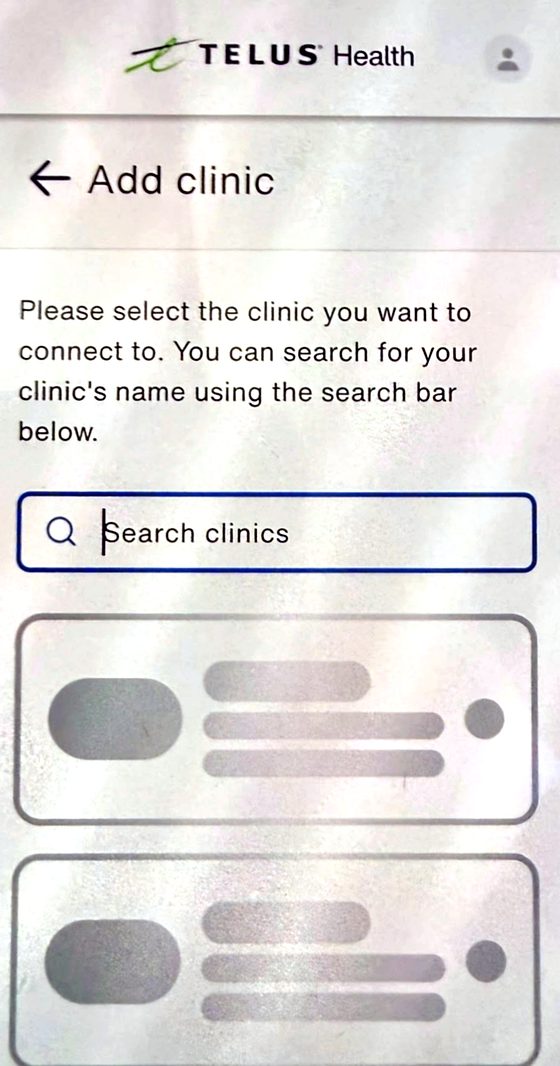
Be patient on this screen. When you open Add clinic
you will see grey boxes like the ones in the picture. That means the list is still loading —
it is not broken. Start typing Trean Clinical Services straight away, then wait.
It can take several seconds, sometimes longer. Do not clear the search, go back, or start again.
3a
Start typing straight away
Tap the search box and immediately type Trean Clinical Services — even while the grey boxes are still showing. The app searches by clinic name only, not by address or phone number.
3b
Wait for it to appear
Give the search time to catch up. If you want to be sure it is us, tap the location under the name to see our address: 11-345 Bloor Street East, Toronto.
3c
Select the + beside Trean Clinical Services
That adds us to your account.
Step 4
Connect to your record
The app matches you to your file using four details: first name, last name, date of birth and health card number. They have to match what we have exactly.
Already a patient
If you have registered with us
- Use exactly the name and details you gave us when you registered. Same spelling, same first name — not a nickname or shortened version — same date of birth, same health card number.
- Tick I have visited this clinic before.
- Select Next, review your profile, select Confirm, then Connect.
New patient
If this is your first time
- Enter your details exactly as they appear on your health card.
- Select Next, then enter and verify your phone number.
- Complete any other fields, then select Register.
Seeing “No match found” or
“Contact your clinic”? Select the X to close it and check your details. It is usually a
middle name, a shortened first name, or a typo in the health card number. If it still will not connect, call us
on 1-833-987-3265 and we will sort it out. In the meantime, you can use the
web portal for messages.
Just need to check a message?
The web portal is the quickest way to read and reply from any browser. Video visits need the app.
Make sense of what you are feeling
Free interactive tools built by our clinical team. General education, and a clear next step when it is time to speak to someone.
Two tools
Both free, no account needed
Weight management
GLP-1 Side Effect Helper
On a medication or thinking about it? See what each side effect means, what eases it, and when to get checked.
Open the tool →
Peptides
Peptide Monitoring Guide
Already using peptides? See what is worth tracking, which blood tests your clinician will want, and when to speak to someone. Trean does not prescribe or supply peptides.
Open the tool →
Heard about us from your coach?
Here is what Trean is, and what happens if you go ahead. It is your decision, and your trainer is only involved if you want them to be.
What you get
A clinical team, alongside the training you already do
Your trainer already sees your progress. Trean adds a licensed clinician and a Sports Pharmacist who take that training seriously — and, with your consent, keep your trainer in the loop.
Your coach
Your trainer, if you want them
With your consent, your clinician and your coach can communicate, so your treatment and your program point the same way.
Prescribing
A licensed clinician assesses you
A physician registered with the College of Physicians and Surgeons of Ontario. The assessment is billed to OHIP.
Safety
Every prescription reviewed
A Sports Pharmacist checks it against your training load and anything else you are taking.
Privacy
Your record stays with your clinical team
Nothing reaches your trainer unless you say so, and you can withdraw that at any time.
How it works
Four steps, starting free
01
Check you qualify
A short check tells you whether we can help, before you pay anything.
02
Assessment
A licensed Ontario clinician reviews your history, your goals and your bloodwork.
03
If you want, your coach is brought in
Only with your consent, and only what you choose to share. Never your full medical record.
04
Care that keeps going
Monitoring on a schedule, adjusted as your training changes.
Check if you qualify
Answer a few quick questions to see if Trean is the place for you.
Talk to us about your gym
Tell us a little about your business and we will be in touch. Partner gyms pay nothing, are never a medical provider, and carry no clinical liability.
Partner enquiry
Tell us about your business
Business contact details only. No client or health information is collected here.
Find a trainer who works this way
Trainers who have worked with Trean clinicians and understand how treatment and training interact. We are building this list carefully rather than quickly.
Why it matters
Care works better with a coach
Patients working with a trainer tend to do better. With your consent, your clinician and your trainer communicate through secure messaging, so your treatment and your program stay aligned. There is no extra cost for this.
No cost
Adding a trainer costs nothing
Not to you, and not to them. No money moves in either direction for a referral.
Your choice
Bring your own, or start without one
You can begin care with no trainer at all and add one later, or keep the one you already have.
Consent
They see only what you agree to
You choose what is shared, from training guidance only through to results. You can stop it at any time.
Coming soon
We would rather have three good ones than thirty
The directory opens once we have trainers we would send our own patients to. We are building it carefully rather than quickly, because a name on a list is worth nothing if we have not worked with them.
Train clients yourself?
Tell us about your practice and we will be in touch.
Thinking about a whole-body MRI?
The pitch is hard to argue with: scan the whole body, no radiation involved, allow us to find anything hiding. It’s the evidence underneath that gets complicated.
What the scan is good at
MRI is excellent at showing soft tissue in detail. If you have a symptom, a targeted MRI can often be the appropriate test. However whole-body screening in people with no symptoms is a different question, and it hasn’t been shown to help healthy people live longer.
The problem is what else it finds
Scan enough of a healthy body and you’ll find something, but more often than not it isn’t clinically meaningful. Studies of whole-body screening MRI report incidental findings in plenty of healthy people, such as a cyst on a kidney, or a small nodule on a lung. These tend to be harmless, but once these findings are discovered they can’t be ignored or forgotten. It leads to another scan, sometimes a biopsy, a referral, and always an additional worry on the patient.
What that costs you
Follow-up tests carry their own risks and their own costs, and they are often not covered. A biopsy is a procedure with real complications. For the small number of people where a scan finds something important early, it can be significant. But for most people, the finding was never going to cause harm.
Where professional bodies land
No major guideline recommends whole-body MRI screening for people without symptoms or specific risk factors. It isn’t due to the cost, or that the technology is poor, but rather that screening a healthy population hasn’t been shown to do more good than harm.
If you still want one
Trean does not arrange whole-body MRI screening, and we do not refer for it. That is a considered position rather than a gap in what we offer, and it follows from everything above.
If you decide to go ahead somewhere else, we would still rather you went in with your eyes open. Understand what an incidental finding is before the scan rather than after it, and make sure whoever arranges it has a plan for following up anything they find. A scan with no one attached to the result is the version that causes harm.
General information, written for everyone reading it. It is not advice about whether you personally should have a scan.
Blood testing at Trean
We customize your blood panel to test what is important to you as an individual. It is not a standard blood panel for everyone. This is a shared decision between you and your clinician to identify what you want to find out, and what result would actually change. From there, we order what is appropriate.
What a reference range really means
When a lab flags a result as outside the reference range, most people read that as a finding. What is important to know is that reference ranges are statistical, not biological. They are built so that about 95 per cent of healthy people fall inside them. That means roughly one healthy person in twenty falls outside the range on any given test, while being perfectly well.
Reference ranges do not account for activity levels and training load, and how the values may differ significantly in active individuals. The range describes how a population varies, rather than a line between health and illness.
Why more tests isn’t better
If one test in twenty comes back flagged in a well person, the arithmetic adds up fast.
| Tests ordered | Chance of at least one flag | Flags from normal variation |
|---|---|---|
| 36 | 84% | about 2 |
| 100 | 99.4% | about 5 |
What has good evidence for a healthy person
The list is short: lipids, blood sugar in the right age and risk groups, iron studies where there’s a reason to look, and a liver fibrosis score for people with specific risk factors.
Almost everything else, including vitamin D, B12, thyroid and hormones, is a test for someone with symptoms or a specific risk, but not a routine test for a healthy person.
Most people aren’t symptom-free
If you’re exhausted despite sleeping, your recovery has fallen off a cliff, your periods have stopped, or you’re taking something you bought online, you aren’t being screened any more. You have a reason for a test, and the test follows the reason. Our intensive intake helps us recognize what tests may be truly valuable.
One question almost nobody asks
When did you last train hard? This changes how several tests should be read. For example, ferritin rises after exercise, so a normal result the day after training doesn’t rule out iron deficiency. Inflammation markers also go up after a hard session, and creatine kinase, which reflects muscle breakdown, can stay elevated for a week. Hemoglobin can look low in endurance athletes simply because blood volume expands with training.
We ask this question on training before you go for your bloodwork, and the answer goes on your requisition. This way we can interpret the lab work based on training load to get a better understanding of what is actually happening.
What happens to your results
Every result is interpreted, not just flagged. A clinician reads it in the context of everything you’ve told us.
If something falls outside what we look after, we refer you on. We write to the specialist, copy your family doctor if you want, and follow up to confirm it was received.
If something is mildly out of range and needs nothing, we address it and tell you what could change that. Sometimes the answer may be to repeat bloodwork in three months, and that is a decision rather than an omission.
General information, written for everyone reading it. It is not about your results and does not tell you what yours mean.
Grip strength, and why we measure it
What is it?
Without preparation or warm up, you squeeze a handheld gauge as hard as you can. This test is incredibly simple but one of the strongest markers in adult health.
What the evidence shows
The largest study is PURE, published in The Lancet in 2015. Each 5 kg drop in grip strength was linked to roughly 16% higher all-cause mortality and about 17% higher cardiovascular mortality. Later reviews have found similar associations.
What that doesn’t mean
These are associations, not causes. A weak grip doesn’t cause early death, but may be a call out to something broader like muscle mass, nerve function, and accumulated health.
So training your grip in isolation misses the point. Squeezing a hand gripper will improve your score without changing what the score stood for.
It is also worth knowing that where studies measure both grip strength and cardiorespiratory fitness (CRF), CRF shows a stronger link to mortality than grip does.
Why we measure it
It tracks change in you. The same measurement over months, against your own baseline, is useful in understanding changes in you. The scale can only tell us so much, but if we see grip also declining, we need to adjust our plan.
It costs almost nothing. A minute, no preparation, no recovery cost.
Getting a number that means something
It is integral to follow appropriate protocol. Position, elbow angle, which hand and how many attempts all change the result, so comparisons only work when the method is the same each time. Hand injuries, arthritis and recent heavy training all affect it, and must be captured and recorded by whoever is testing you.
General information, written for everyone reading it. Grip strength testing is done in person at select partner gyms.
Choosing a proactive health service
Nine questions worth asking any private health service, what the answers tell you, and ours.
There are far more private health services in Canada than there were three years ago, and from the outside they all look the same. Comprehensive testing. Personalised insights. A dashboard.
Underneath they differ in ways that only matter once something is actually found. Here are the questions we would ask. Ask them of us too — our answers are at the end.
1. Can anyone here actually prescribe?
People skip this one. Several services test thoroughly, interpret carefully, then stop, because they are not a medical practice. What you get is a report and a suggestion to see your family doctor.
That is a legitimate service. Just be clear what you are buying. If a test finds something treatable, a service that cannot prescribe hands the problem back to you.
2. Who checks the prescription?
A prescription checked only by the person who wrote it has one set of eyes on it. Pharmacist review is standard in hospitals for good reason: it catches interactions, dosing problems and contraindications.
Ask whether it happens at all.
3. Was the panel designed, or assembled?
Bigger panels are easier to sell. A hundred and fifty markers sounds more thorough than thirty-six.
The arithmetic is not on their side. Reference ranges are built so that about 95% of healthy people fall inside them — which means roughly one healthy person in twenty falls outside on any given test. Run a hundred tests on a well person and you should expect about five flags from normal variation alone. None of them mean anything, and every one needs explaining, chasing or repeating.
Ask what each test would actually change.
More tests is not more thorough. It is more noise, and the follow-up carries its own cost and risk.
4. What do the words actually mean?
Some terms sound clinical without being defined anywhere.
“Optimal.” Calling a result suboptimal implies there is an established better value and evidence that moving toward it helps. For a few markers that is true. For many now sold in large panels it is not. An optimal range is usually narrower than the lab range, rarely published, and conveniently places more people outside it.
“Imbalance.” Not a diagnosis. No test, no threshold, no agreed definition. It can mean whatever the person selling the correction needs it to mean.
“Root cause.” Appealing, because everyone wants the real reason rather than a patch. But most chronic conditions have no single root cause — there is genetics, behaviour, environment and luck.
“Biological age.” A number saying you are tracking younger or older than your years is a risk estimate presented as a fact. Different methods give different answers on the same person, the same sample can give different answers at different labs, and no regulator has cleared any of them.
None of this is a scandal. It is worth recognising each for what it is.
5. Do you sell what you recommend?
We would treat this as a bright line.
When the person telling you what you need is also the person selling it, the advice is no longer clean — and the effect on their judgement is usually invisible even to them. It does not require anyone to be dishonest. The incentive simply points the wrong way.
Ask it directly: do you sell what you recommend, and do you earn anything if I buy it?
6. Is it approved for what you are offering it for?
Some of what gets sold in this space has not been approved for anything, and the clearest example is regenerative medicine.
In Canada, cell therapies count as drugs. Not procedures, not something a clinic can simply decide to offer. Which means they have to be approved before anyone can sell them to you.
Using your own cells changes nothing. The usual argument is that cells taken from your own body must be safe, so the rules should not apply. Health Canada has answered that directly: your own cells are covered too.
Almost nothing has been approved. The few cell therapies Health Canada has authorised are for serious illness — certain cancers, and a complication of bone marrow transplant. None has been approved for skin, hair, or ageing. Health Canada has warned the public that unapproved cell treatments have not been shown to be safe or to work, and can cause serious infections, and it has ordered clinics to stop offering them.
The same question applies elsewhere. Intravenous vitamins are real medicine in someone who is genuinely deficient and cannot absorb nutrients by mouth; in a healthy person with a normal diet the evidence is very thin. Peptides sold for recovery or fat loss are mostly not approved for those uses in Canada.
So: is this approved by Health Canada for what you are offering it to me for? If the answer is anything other than a straight yes, you are paying for something that has not been through the process.
7. Does anyone understand how you train?
If you train seriously it changes how your results should be read. Creatine kinase is high after heavy lifting and means little on its own. A medication decision in a heavy block is different from the same one in a rest week.
A generalist service is not wrong. It is just not built for that.
8. Where does your data live?
Ask who holds it, whether it sits under provincial health privacy law, and where it is processed. Ask what happens if you cancel.
Ask whether a coach can see any of it, what exactly, and whether that is something you switch on rather than something that happens by default.
9. What do you say when the answer is no?
This is the one that tells you most. A service that has never turned anyone away is either extraordinarily lucky or is not really assessing anyone.
Ask what proportion of people they decline, and what happens to those people. And be wary of testimonials as an answer — you are hearing from the people who were happy, not from everyone who tried it. Ontario physicians are not permitted to use patient testimonials in advertising, which is worth knowing when you see them.
Our answers
Yes, we can prescribe. Care is delivered by physicians registered with the College of Physicians and Surgeons of Ontario. Every prescription is reviewed by a Sports Pharmacist before it is dispensed.
Our panels are chosen with you, test by test, against what a result would change. We do not sell supplements, and we take no commission on medication or laboratory testing.
We do not offer stem cell or regenerative treatments, IV vitamin therapy, or biological age testing, and we do not prescribe or supply peptides. We do not use testimonials.
Your record is held by Trean Clinical Services under Ontario health privacy law. Nothing reaches a trainer unless you expressly consent, and you can withdraw that at any time.
Where we do test, we have tried to be honest about the limits. Our VO2 equipment measures oxygen only, so it cannot tell you anything about fuel use. Body composition figures are estimates, and the trend matters more than the number. Wearable data carries its source and its reliability alongside it.
And we say no. If a program is not appropriate for you, or you would be better served by your family doctor or a specialist, your clinician will tell you. We would rather lose a sale than prescribe something that is not right.
General information, written for everyone reading it. It is about practices, not about any particular clinic or practitioner, and it is not advice about whether a specific service is right for you. If you are considering something and are unsure, ask the questions above and ask your own clinician.
Body composition: what the numbers are worth
DEXA and bioimpedance, what each actually measures, how far off they can be, and why the trend matters far more than the number.
The scale tells you something moved. It has no idea what. Drop twelve pounds, four of them muscle, and it will happily call that a win.
So measuring body composition is worth doing. The question is really how much to trust the number you get back.
There’s no perfect method outside a lab
Every method available to you is an estimate. They differ in how good the estimate is, and in what assumptions they make when they can’t measure something directly.
The reference standard in research is a four-compartment model, which combines several measurements to separate fat, water, protein and mineral. It’s slow, expensive and not something a gym or clinic offers. It exists to judge everything else against.
Everything you can actually book is measured against that.
DEXA
A DEXA scan passes two low-dose X-ray energies through you and separates tissue into fat, lean soft tissue and bone. It takes about ten minutes and you lie still.
It’s the most useful thing most people can access. It gives regional detail, so you can see where fat and lean mass sit, and repeated on the same machine it tracks change well.
What it isn’t is a gold standard. DEXA is a three-compartment method and it makes its own assumptions, particularly about the water content of lean tissue. It’s a very good practical reference, not truth.
Two limits matter in practice. Machines aren’t interchangeable. Different manufacturers, and even different software versions, produce different numbers on the same person. A DEXA from one clinic can’t be compared to a DEXA from another. And hydration and recent food shift the result, which is why the scan conditions matter as much as the scan.
Bioimpedance
Bioimpedance passes a small current through you and measures resistance. Fat and lean tissue conduct differently, so resistance carries information about body composition.
But resistance isn’t body fat. To get from one to the other the device applies a prediction equation, and that equation rests on an assumption: that lean tissue is a fixed proportion of water, conventionally about 73%.
That assumption is where the error comes from. Hydration status, a recent meal, a hard training session, alcohol, where you’re in your menstrual cycle, even skin temperature all move the number without anything about your body actually changing.
What the evidence shows
A 2026 systematic review in the Journal of Functional Morphology and Kinesiology compared bioimpedance devices against the four-compartment model across twelve studies in healthy adults.
The average error looked small: mean bias for body fat percentage ranged from about −3.5% to +4.4%. But the spread around that average was the finding. Limits of agreement typically spanned 15 to 20 percentage points.
The authors concluded the devices weren’t equivalent to the reference method, and that a small average difference hides non-equivalence at the individual level.
In plain terms: across a group the errors cancel out and the average looks fine. For one person, on one day, the number can be a long way off.
Not all devices are equal. Eight-electrode machines, the kind you stand on while holding handles, agree with DEXA better than four-electrode ones, and both agree better than a bathroom scale that only contacts your feet. In one comparison of consumer and clinical devices, agreement with DEXA ranged from unacceptable for a consumer scale to moderate for clinical-grade units.
The distinction that actually matters
Here’s the bit almost nobody explains, and it clears up most of the confusion.
Precision and accuracy are different things. Precision is whether you get the same answer twice. Accuracy is whether the answer is right.
Bioimpedance devices are precise. Measured twice in a session they typically agree within 2%. That’s genuinely good. But precise isn’t accurate, and the same review that found excellent repeatability found poor agreement with the reference method.
A device can be reliably wrong. If it reads three points high on you, it will keep reading three points high — which is useless for knowing your actual body fat, and extremely useful for tracking whether it’s moving.
So how should you use it?
Treat the absolute number with suspicion. If a scan says 22% and you expected 18%, the honest answer is that either figure could be closer to the truth.
Treat the trend as the real measurement. Same device, same machine, same conditions, repeated over months. That’s where the information is.
Standardise the conditions or you’re measuring noise. Same time of day, similar hydration, no training in the hours before, no large meal beforehand, and for women, ideally the same point in the cycle. A scan that ignores these isn’t comparable to the one before it.
Never compare across devices. A DEXA against a gym bioimpedance reading, or one clinic’s machine against another’s, isn’t a comparison. It’s two different estimates with different assumptions.
What we do
We use body composition the way the evidence supports: as a repeated measure on one device, read alongside everything else, rather than as a number that stands on its own.
It matters most during weight loss, where the question isn’t how much weight came off but what kind. Scale weight falling while lean mass holds is a good outcome. Scale weight falling while lean mass falls with it’s a signal to change something — protein, training, the pace of loss, sometimes the treatment.
That’s also why grip strength sits alongside it. Two imperfect measures pointing the same way is more convincing than either alone.
And your record marks where each figure came from, so a gym bioimpedance reading and a DEXA are never averaged together or treated as the same kind of evidence.
General information, written for everyone reading it. It is not about your results and does not tell you what yours mean. Body composition figures are estimates, and a single reading should not be treated as a diagnosis or a verdict on your progress.
Wearables: what the data is worth
Consumer wearables aren’t medical devices. What that means, which measures hold up, and exactly what we take into your clinical record.
If you wear a ring or a watch, you’re already collecting more data about yourself than most clinics will ever ask you for. So what’s it actually worth, and what should a clinician do with it?
Here’s our honest answer.
They aren’t medical devices
Consumer wearables are consumer electronics. Health Canada hasn’t licensed them as medical devices, and the manufacturers are careful to say so in their own terms.
That’s not a scandal. It reflects a real difference: a medical device has to prove it measures what it claims to measure, to a standard, before it can be sold for that purpose. A consumer wearable does not.
So nothing your ring or watch reports is a diagnosis, and no number from you should be treated as a clinical result. Where a figure matters clinically, it needs measuring properly.
Some of it’s good. Some of it’s not.
The quality varies enormously depending on what’s being measured, and lumping it all together as "wearable data" hides that.
Heart rate at rest is generally reliable. Optical sensors do this well when you’re still, and resting heart rate tracked over weeks is genuinely useful.
Heart rate variability is measured reasonably well but interpreted badly. The number moves with sleep, alcohol, illness, stress and measurement position. A single reading tells you very little. A trend over weeks tells you something.
Steps and workout duration are fine. They are counting, not inferring.
Sleep duration is reasonable. Sleep staging is not. Deciding whether you were in deep or REM sleep from wrist movement and pulse is an inference, and it agrees poorly with the laboratory method that actually measures it.
Blood oxygen from a wrist or finger sensor isn’t comparable to a medical pulse oximeter, and consumer devices aren’t validated for the clinical uses people assume.
The further a number sits from something the device can physically measure, the less you should trust it.
The scores are the weakest part
Most devices wrap all of this into a single daily score: readiness, recovery, body battery, whatever the brand calls it.
Those scores are proprietary. The formula isn’t published, it changes between software versions, and it can’t be reconstructed or checked by anyone outside the company. Two devices on the same person on the same morning will disagree.
They can be useful to you personally, as a rough prompt to back off or push on. They aren’t something a clinician can reason from, because nobody outside the manufacturer knows what went into them.
What we take, and what we leave
With your consent, you share a small, specific set of measures into your clinical record: resting heart rate, heart-rate variability, sleep duration, steps and workout summaries.
We deliberately don’t take sleep staging, blood oxygen, or the proprietary readiness and recovery scores. Not because they are uninteresting, but because they are either not accurate enough to act on or not open enough to check. That exclusion is built into the system rather than left to judgement.
We also don’t take a VO2 max estimate from a watch. That number is a prediction from your heart rate response, not a measurement of the oxygen you used. If it matters, it is worth having measured properly.
Every number carries its own label
This is the part that makes the rest work. In your record, every value carries two things alongside it: where it came from, and how well that instrument measures that quantity.
A sleep duration from a ring is genuinely measured, and simultaneously a limited estimate. Both facts travel with the number. So a clinician looking at your record can see at a glance which figures are solid and which are indicative, and is never invited to over-trust a consumer device.
A laboratory result and a wrist reading don’t sit in the same field, aren’t averaged together, and aren’t treated as interchangeable.
What it actually changes
Wearable data rarely decides anything on its own. What it does is give context that would otherwise be missing.
A resting heart rate that has been climbing for three weeks is worth knowing before a consultation. Sleep that collapsed when a dose changed is worth knowing. Training load that tripled the month before a blood test explains results that would otherwise look alarming.
None of that’s a diagnosis. All of it makes the conversation better than one built on what you can remember.
What it won’t do
Nothing is automated. No score triggers a message, no threshold sends you a recommendation, and no algorithm decides anything about your care. A clinician reads it, in context, and makes the call.
Your trainer doesn’t get it by default. Sharing with a coach happens only if you consent, covers only what helps them adapt your training, and can be withdrawn.
We don’t use it to market to you. Data you share for care is used for care.
And sharing anything is optional. No part of your care depends on it, and plenty of our patients share nothing at all.
General information, written for everyone reading it. Consumer wearables are not medical devices and nothing they report is a diagnosis. If you have a symptom that worries you, speak to a clinician rather than waiting for a device to tell you something.
What the weight-loss trials actually show
Trial data for the two medication classes used in weight management, at 12 weeks, 24 weeks and beyond — and what those numbers can’t tell you about yourself.
Everyone asks the same two things: what should I expect, and how long will it take. The honest answer is that trials tell you what happened, on average, to people in a study. They can’t tell you what will happen to you.
Here’s what the published trials actually report, and what they do not.
What these trials studied
Two classes of medication have been tested at scale for weight management. One acts on a single hormone pathway (GLP-1). The other acts on two (GLP-1 and GIP). Both are given as weekly injections alongside diet and activity changes, and both are approved in Canada for chronic weight management.
All the figures below come from randomised controlled trials run by the manufacturers. They aren’t our results, not a promise, and not a prediction about you.
Why twelve weeks is early
Most trials run for 68 to 72 weeks. Twelve weeks sits inside the dose build-up phase for these medications, so it’s early to judge anything.
A post-hoc analysis of the SURMOUNT-1 trial of the dual GLP-1/GIP medication looked at where people were at twelve weeks. About 82% had lost at least 5% of their body weight by then. About 18% had not.
That second group matters. Of the people who had lost less than 5% at twelve weeks, 70% had reached at least 5% by week 24, and 90% had reached it by week 72.
A slow start at twelve weeks didn’t predict failure. Most slow starters caught up when treatment continued.
What twenty-four weeks looks like
By around twenty-four weeks the dose build-up is generally complete, so the picture is clearer.
In a head-to-head trial comparing the two classes, 44% of people on the dual GLP-1/GIP medication had lost at least 15% of their body weight by week 24, against 21% on the GLP-1 medication.
A separate analysis found the point at which weight loss levels off tends to fall between about 24 and 36 weeks, later for people starting at a higher body weight.
Where the trials end up
For context, at 72 weeks in the largest trials the dual GLP-1/GIP medication produced average weight reductions of about 16% to 22.5% depending on dose, and the GLP-1 medication produced about 15% at 68 weeks. Placebo groups lost roughly 2 to 3%.
A head-to-head trial at 72 weeks found about 20% with the dual medication.
What these numbers don’t tell you
These are averages, and the spread is wide. Some people in these trials lost far more than the average. Some lost very little. An average isn’t a forecast for an individual.
Trial conditions aren’t real life. Participants were screened, supported closely, seen regularly and given structured diet and activity input alongside the medication. That support is part of the result.
These trials studied specific populations. Most enrolled adults with obesity, or overweight with a weight-related condition, and excluded people with diabetes. If you don’t resemble the people studied, the numbers apply less well.
Weight came back when treatment stopped. In an extension of one trial, participants regained about two thirds of the weight they had lost within a year of stopping, and the improvements in other markers drifted back toward where they started.
And not everyone tolerates these medications. Gastrointestinal side effects were common, and some people stopped because of them.
Why we offer twelve and twenty-four weeks
The twelve-week course is a reasonable starting point, and enough to see whether you tolerate treatment and whether the wider plan is working.
The twenty-four week course exists because the trials suggest twelve weeks is often too early to judge, and because a slow start doesn’t appear to predict a poor finish.
Neither length is a course of medication. They’re courses of care: assessment, monitoring, bloodwork, body composition and adjustment. Whether medication is part of that’s a clinical decision made with you, and for some people the answer is no.
General information, written for everyone reading it. The figures on this page come from published clinical trials and describe what happened to groups of people in those studies. They are not results achieved by Trean patients, not a prediction, and not a recommendation that you take any medication. Treatment is never guaranteed. A licensed clinician decides what is appropriate for you, and will discuss the benefits, the risks and the alternatives before anything is prescribed.
VO2 peak, and why it isn’t your max
Why almost nobody hits a true max, what the test is actually good for, and the one thing our equipment can’t tell you.
Almost every number reported as a VO2 max isn’t one. That sounds like nitpicking, but it leads to the useful part.
The two terms, plainly
VO2 max is the highest rate at which your body can take in and use oxygen. You know you’ve reached it because the oxygen you use stops climbing even as the work keeps getting harder. The graph flattens. That flattening is called a plateau, and it is the proof.
VO2 peak is the highest value recorded during a test where that flattening never happened. It’s the most you managed on the day, not a demonstrated ceiling.
It is the same test either way, and the same effort from you. The only thing that separates the two words is whether the plateau appeared.
Why most people get a peak
Reaching a true max means pushing until oxygen delivery is the thing that stops you. Usually something else stops you first: your legs give out, your breathing feels unbearable, or you’ve simply had enough.
That has nothing to do with how hard you tried. It simply means the limit you ran into wasn’t the one the test was looking for.
So unless someone tells you a plateau was reached, the honest word for your number is peak.
If nobody mentioned a plateau, you got a peak. Most people do.
None of this makes the number less useful. The big studies linking fitness to living longer were run on exactly this kind of test, so what they really measured was peak. Calling it by the right name costs you nothing.
The number everyone talks about matters least
Your peak barely moves. A good deal of it you inherited, shifting it takes months, and knowing the number tells you nothing about what to do on Tuesday.
The part of the test that does tell you what to do is everything else it measures.
Where your easy pace really sits
As the work gets harder, your breathing changes twice. The first change marks roughly where easy stops being easy. The second sits near the point where things fall apart.
Those two points are where your training zones actually are, measured on you rather than guessed from a formula.
The usual alternative is subtracting your age from 220. That’s an average, and plenty of people sit twenty beats either side of it. Get it wrong and you can spend months on easy days that aren’t easy, wondering why you’re tired and not improving.
Why two people with the same number can be very different
Put two people on the same machine at the same pace and one of them will be using less oxygen than the other. That is efficiency, and it decides whether an effort feels steady or feels like a fight.
It improves faster than your peak does. If your peak has sat still for six months and you’re still getting quicker, this is usually why.
About zone 2
The part that holds up is straightforward: most of the gain comes from doing plenty of easy work you can recover from, and going easier lets you do more of it.
The part that gets overstated is the claim that this one intensity does something for your mitochondria that harder training cannot. Harder training does it too. Easy work just happens to be easier to repeat week after week.
The practical problem is that most people have no idea where their zone 2 actually sits. If the number came from a formula, there is a good chance you are training above it, and that is the usual reason easy days quietly stop being easy.
One thing we can’t tell you
You’ll read that this kind of test shows whether you’re burning fat or carbs. That’s real, and it’s useful, and our equipment can’t do it.
Working that out means measuring the carbon dioxide you breathe out, not just the oxygen you take in. Our analyser measures oxygen only. Without the carbon dioxide reading there is no way to work out the ratio, so there is no answer to give you.
It also means the resting metabolic rate we give you assumes a fuel mix rather than measuring one. Fine for watching your own trend, but worth knowing.
If fuel use is what you’re after, you need a machine with a CO2 sensor. We’d rather say so than sell you a test that can’t answer your question.
What you get
You get your peak, described as a peak rather than dressed up as a max. You get the two points where your breathing changes, so your training zones come from your own physiology instead of a formula. You get your oxygen cost at a given pace, so efficiency can be tracked over time. And you get the same test on the same machine each visit, which is what turns a set of numbers into a trend.
Your clinician reads it next to your bloodwork and your training. With your consent, the parts your coach needs go to your coach.
What it’s like
A mask over your face, work that gets harder until you stop. Hard near the end, and about ten to fifteen minutes of real effort.
Because it’s maximal, we screen you first. Chest symptoms and uncontrolled blood pressure need looking at before you go anywhere near it.
General information, written for everyone reading it. VO2 testing is done in person, either at an independent testing facility or at select partner gyms, and needs clinical screening beforehand.
Peptides: where we stand, and why
Peptides are confusing, and a lot of that is because one word is being asked to cover two completely different things.
Two things, one word
A peptide is just a short chain of amino acids. That’s chemistry, not a category of treatment. Plenty of ordinary medicines are peptides.
Approved peptide medicines have been through the full process. Trials were run, data was submitted, Health Canada authorised them for a specific use. They have known doses, known side effects, and a manufacturer who is accountable.
Unapproved peptides are what people usually mean in a gym. Compounds sold for recovery, growth or longevity. None is authorised by Health Canada for human use. Most have never completed a review at all.
What compounding is, and is not
Compounding is a normal part of pharmacy. A pharmacist prepares a medicine for one patient for a real reason: a child who needs a liquid, someone allergic to a dye, a strength nobody makes.
It isn’t a way around approval. Preparing something doesn’t create the evidence approval would’ve required. When a clinic calls an unapproved substance "compounded", that word is doing a lot of reassuring it hasn’t earned.
The FDA decision, and what it means here
You may have read that the FDA banned peptides. Not quite.
In late 2023 the American regulator moved nineteen peptides into a category meaning they couldn’t be compounded, citing immune reactions, impurities and thin safety data. In April 2026 twelve came back out, largely because the nominations behind the review were withdrawn.
Removal isn’t approval. It returned them to a queue. And this is a United States process with no legal effect in Canada.
The safety questions were never answered. They were set aside.
What the evidence looks like
For most of these compounds: promising idea, animal data, very little in humans.
Studies tend to be in rodents at doses that don’t translate, or small trials without control groups, measured over weeks. Long-term safety data is largely absent. That matters most for compounds acting on growth and repair, because those are the same pathways involved in things you don’t want growing.
This isn’t the same as saying they do nothing. It’s saying nobody currently knows.
The grey market
Because they are unapproved, these compounds reach people through sellers operating outside the medicines system, often labelled "for research use only". That phrase exists to shift legal responsibility, not to describe the buyer.
Certificates of analysis are often not what they appear to be. They may be produced by the seller, relate to a different batch, be copied from another product, or simply be invented.
When you buy from this market you don’t know what’s in the vial, how much, what else came with it, or how it was stored. However professional the packaging looks.
Why we don’t prescribe them
Trean doesn’t prescribe or supply peptides. Not as a program, not on request.
Our rules require that anything we recommend can be traced to evidence supporting it. For these compounds that evidence doesn’t exist yet.
What we’ll do is monitor. A lot of people are using these already, sourced privately, with no bloodwork and no oversight. Refusing to engage doesn’t make that safer. It just makes it invisible.
So a clinician can agree which tests matter, track them on a schedule, read them alongside your training, and say plainly when something looks unsafe or looks like it’s doing nothing. The decision stays yours. It’s just made with information.
This position isn’t permanent
If good human evidence emerges for a specific compound in a specific use, our position on it should change, and it will. What won’t change is the standard: evidence in people showing a benefit worth the risk.
General information, written for everyone reading it. Trean does not prescribe or supply peptides. If you are using something already, tell your clinician, because they can only help with what they know about.
GLP-1 side-effect helper
Tap a side effect to see what it means, what eases it, what a clinician can consider, and when to get checked.
Resources · Weight management
GLP-1 side effects,
and what actually helps.
and what actually helps.
Tap any symptom to see why it happens, what helps, the prescription options your clinician may consider, and whether it's worth a check-in.
✅ Reviewed by Trean's clinical team📍 Ontario⏱ 5-min read + interactive tool
Why these medications cause side effects
medications work partly by slowing how quickly your stomach empties and by acting on appetite signals in the brain. That's exactly why they help you eat less, but it's also why the most common side effects are digestive: nausea, fullness, constipation, and occasionally reflux or vomiting. Because the effect is dose-related, symptoms tend to appear or worsen right after a dose increase, then ease as your body adapts.
This is also why how you titrate matters so much. Going up in dose too quickly is the single most common reason people struggle, and slowing the schedule down is often the simplest fix.
Interactive · What are you feeling?
⚠️
This is general education, not medical advice, not a diagnosis, and not a substitute for your clinician. Using it does not create a clinician–patient relationship. It cannot see your full picture. Do not start, stop, or change any medication based on it, that is your clinician’s decision. If something feels seriously wrong, seek urgent care or call 911.
Tap the symptom that applies
When to stop waiting and call your clinician
Most symptoms are a comfort problem, not a safety one. But a few deserve prompt attention rather than patience:
- Severe or persistent stomach pain, especially if it spreads to your back, this can signal pancreatitis or a gallbladder problem.
- Vomiting you can't keep fluids down with for more than a day, dehydration matters.
- Signs of infection at an injection site, spreading redness, warmth, pus, or fever.
- Repeated low blood sugars, particularly if you also take insulin or a sulfonylurea, your other medications may need adjusting.
None of these mean you've done anything wrong, they just mean a clinician should take a look rather than you waiting it out.
What the evidence shows about this treatment
A common question is simply “how much difference does this actually make?” The chart below shows the broad pattern reported in published clinical trials. It is general education, not a prediction for you: real results vary widely from person to person, and depend on the medication chosen, the dose reached, how long treatment continues, and what happens alongside it with diet, training and sleep.
Average weight change reported in trials
Illustrative ranges over roughly 12–18 months. Not a promise of results.
Averages from published trials, shown to give a sense of scale. Individual results vary considerably, and some people respond much less or not at all. Which medication is appropriate for you, whether it is available in Canada, and what you could reasonably expect are clinical questions. Speak with a clinician at Trean Clinical Services rather than drawing conclusions from this chart.
Not every medication in this class is approved or available in Canada, and availability changes. We have deliberately not named products here. A physician at Trean Clinical Services can tell you what is actually available to you and whether any of it is appropriate.
How a clinician-led service changes this
The difference between struggling on this treatment and succeeding on it usually comes down to support and adjustment: titrating at the right pace for you, managing side effects properly, checking the right bloodwork, and protecting muscle as you lose weight. That's the gap a do-it-yourself prescription leaves, and exactly what Trean is built to close.
At Trean, a licensed clinician sets and adjusts your plan, a Sports Pharmacist reviews every prescription, and, if you have a trainer on your team, your training and body-composition data feeds into the picture, so you lose fat rather than muscle.
Common questions
How long do GLP-1 side effects last?
For most people, the digestive side effects are worst in the first week or two of a new dose and then settle as the body adapts. If they're not easing, that's usually a sign the dose is climbing too fast, a conversation worth having with your clinician.
Can I do anything to prevent nausea before it starts?
Smaller, slower meals, going easy on fatty and fried foods, staying hydrated, and not rushing dose increases all reduce the odds. The interactive tool above lays out the specifics by symptom.
Is losing muscle on a GLP-1 something to worry about?
It can be, if protein intake and resistance training aren't protected during rapid weight loss. This is one reason Trean integrates trainer data, so your team can track lean mass and keep your loss coming from fat.
Do I need a referral to start with Trean?
No. You complete a short eligibility check, and if you qualify, you meet a licensed clinician who assesses you and decides what treatment, if any, is appropriate. No referral from your family doctor is needed.
Prescription options shown in the tool are decided by your clinician at a consult, never automatically. This page is educational and does not replace personalised medical advice. Medical care is provided by Trean Clinical Services Inc., an independent licensed practice.
Peptide monitoring guide
What to watch, which blood tests your clinician will want, and how it is managed safely. Trean does not prescribe or supply peptides.
Trean tools
Monitoring your
peptide therapy.
peptide therapy.
See what's worth tracking, which blood tests your clinician will want, and when to speak to a clinician.
⚠️
This is general education, not medical advice, not a diagnosis, and not a substitute for your clinician. Using it does not create a clinician–patient relationship. It cannot see your full picture. Do not start, stop, or change any medication based on it, that is your clinician’s decision. If something feels seriously wrong, seek urgent care or call 911.
Trean does not prescribe or supply peptides. We do not start, source, or sell them, and this page is not a recommendation to use any peptide. What Trean offers is monitoring only: if you are already on peptide therapy, a clinician can assess you, order the right bloodwork, and track your safety over time. Many peptides aren't Health Canada approved and are used off-label, this guide is for understanding that monitoring, not for starting anything on your own.
Choose a peptide
Trean does not prescribe or supply peptides, we monitor. Labs are booked through Trean and reviewed by your clinician. Medical care is provided by Trean Clinical Services Inc., an independent licensed practice. This tool is general education, not medical advice.
How a clinician actually decides
There’s no single right treatment for a goal. There’s a right treatment for a person.
The problem we're solving
Three people are helping you.
None of them can see the whole picture.
None of them can see the whole picture.
Your trainer knows how you're moving. Your prescriber knows what you're taking. Your Sports Pharmacist knows how the medication behaves. In most people's lives these three never speak, so decisions get made on fragments, and you're the one holding the pieces together.
The current state
Everything routes through you, and nothing routes between them.
The cost of that gap is specific. You start a medication that changes your appetite, but your trainer doesn't know, so your program doesn't change, and you lose muscle alongside the fat. Your bloodwork shifts, but nobody connects it to the training block you just started. You feel awful in week three and assume it's normal, because there's no one obvious to ask.
The problem isn't that any one of these professionals is doing a bad job. It's that each is working from a fraction of the information, and nobody owns the join.
What changes when the three actually connect
Same three roles. The difference is that information moves between them, with your consent, and with you at the centre rather than in the middle.
The Trean model
Three roles, one shared picture. You stay at the centre and control what’s shared.
The Clinician
Assesses you, decides whether treatment is appropriate, prescribes if it is, and owns the medical decision. They're the only one who can, and the only one who should.
Brings: assessment, prescribing authority, bloodwork interpretation, medical accountability.
The Sports Pharmacist
Reviews every prescription against everything else you take, and, unusually, against how you train. Flags interactions, timing, and what a medication will do to your energy, hydration and recovery.
Brings: medication expertise, interaction checking, timing guidance, an athlete's-eye view.
The Trainer
Sees you two or three times a week, far more often than any clinician will. They notice changes in your lifting, energy and recovery, and they can adapt the program when the plan changes.
Brings: frequency, body-composition measurement, real adherence data, and the ability to change what you actually do.
One line that matters
Your trainer never recommends medication and never sees your medical record. They receive a limited, training-relevant slice, and only if you say yes. Medical decisions sit with the clinician; the Sports Pharmacist checks them; the trainer adapts around them. Everyone stays in their lane, which is precisely what makes connecting them safe.
Four kinds of data. None of them enough alone.
Each answers a different question. The value is in the overlap, which is exactly the part almost nobody assembles.
🩸 Bloodwork
Metabolic markers, hormones, and the safety labs relevant to whatever you're taking.
Answers: what's happening inside?
⚖️ Body composition
Fat mass and lean mass tracked over time, from a gym scan (Evolt, InBody or DEXA), not a bathroom scale.
Answers: what kind of weight is moving?
🏋 Training data
Load, volume, strength trends and attendance, what you're actually doing, recorded by someone who's there.
Answers: is the stimulus still there?
⌚ Recovery & wearables
Sleep, resting heart rate and recovery trends between sessions.
Answers: are you absorbing the work?
Here's the case for putting them together. The scale says you've lost twelve pounds, good news, until a body-composition scan shows four of them were muscle. Your bloodwork looks fine in isolation, until it's read next to a training block that just doubled in volume. You feel flat, and it isn't the medication, it's that you've been sleeping six hours since the new job started.
Any single number can mislead. Read together, they usually tell the truth.
What it looks like in practice
An illustrative walk-through of how the triad works when someone starts a medication for weight loss while training seriously.
Illustrative example, not a real patient, and not a promise of results
1
Trainer
The starting point already has data in it
Someone has been training three times a week with the same coach for eight months. Her gym has recorded body composition every six weeks. Strength is up; body fat has barely moved. She wants to lose weight without losing what she's built, and asks her trainer what to do next.
2
Trainer → Clinician
The trainer refers, and doesn't diagnose
The trainer doesn't suggest a medication. That isn't their role, and doing it would be the fastest way to hurt someone. They refer her to Trean's clinical team and, because she consents, her body-composition history and training record go with her.
3
Clinician
The assessment starts with whether, not which
A licensed clinician assesses her: history, bloodwork, what's driving the plateau, and whether anything rules treatment out. That last step matters most. If treatment isn't appropriate, this is where it stops, and that's a good outcome, not a failed one. In this example it’s appropriate, and a medication is prescribed.
4
Sports Pharmacist
The prescription gets a second set of eyes, with training in view
The Sports Pharmacist reviews it before dispensing: interactions with everything else she takes, how the dose will step up over time, and the part most reviews miss, what this will do to appetite, hydration and energy in someone lifting three times a week. Starting this class of medication tends to reduce appetite sharply, which puts protein intake at risk exactly when it matters most.
5
Sports Pharmacist → Patient + Trainer
The adjustment reaches both people who need it
This is the step that doesn't exist anywhere else. The practical guidance goes to her and, with her consent, to her trainer: protein is now the priority and will be harder to hit; keep resistance training in, because this is when lean mass is most at risk; expect lower energy in the days after each step up; watch hydration. Her trainer doesn't need her diagnosis to act on that, they need to know the plan changed.
6
Trainer
The program changes that week, not three months later
Volume eases through the first step up; resistance work is protected rather than swapped for extra cardio; hard sessions move away from the days she tends to feel flattest. None of that’s a medical decision. All of it changes the outcome.
7
Everyone
The next scan answers a better question
Six weeks on, the question isn't "how much weight has she lost?" It's "how much of the loss was fat, and did she keep her lean mass?", with training records and bloodwork sitting beside the answer. If lean mass is slipping, that's a signal the clinician, the Sports Pharmacist and the trainer can each act on, in their own lane, before it becomes a problem.
The reasoning behind the advice.
Where the rules come from, and who checks them.
Everything described above runs on a clinical rules and evidence library that we built and maintain ourselves. Every rule in it’s written by a person, cites the evidence it rests on, and is reviewed and approved by a physician before it can be used. Our Medical Director owns the library, and it’s developed with input from clinicians practising in sports and performance medicine, and from a Sports Pharmacist whose review covers medication interactions with training and anti-doping considerations.
Two things follow from that, and they are the reason it exists. Nothing reaches you that a clinician hasn’t approved, and every recommendation can be traced back to the rule and the evidence behind it, rather than appearing from a model no one can inspect. We do use software to help draft and organise, as most modern practices do, but a named clinician reviews, decides and signs. The judgement is theirs.
The library is reviewed on a schedule and updated when the evidence changes. Where a cited source is withdrawn or superseded, the rules that depended on it are re-reviewed rather than left standing.
What good actually looks like
Useful wherever you go, us or anyone else.
Warning signs
- A prescription with no baseline bloodwork
- Weight tracked by scale alone, with no measure of what kind of weight is moving
- No scheduled follow-up, just "message us if there's an issue"
- Nobody reviews the prescription except the person who wrote it
- Your trainer finds out you've started something from you, weeks later
- A confident promise about how much you'll lose
What to expect instead
- An assessment that ends in a step forward in trying to achieve your vision
- Baseline measurements, then fat and lean mass tracked separately
- A named follow-up schedule agreed before you start
- A Sports Pharmacist reviewing every prescription independently
- Your training adapting in the same week the plan changes
- A range and a plan, not a guarantee
What Trean is, and what we’re not
Being clear about scope is part of good care. If you need something outside it, we’ll tell you and point you to the right place rather than stretch to fit.
What we do
- Assess, and where appropriate prescribe and monitor, in the areas we focus on: weight and metabolic health, hormone health, menopause, sexual health and related areas
- Order and interpret the bloodwork we request as part of your care with us
- Review every prescription with a Sports Pharmacist before it’s dispensed
- Work alongside your trainer — with your consent, through secure messaging
- Provide ongoing follow-up and adjust your plan as your body responds
What we’re not
- Not an emergency service. We can’t help with anything urgent. If you’re experiencing an emergency, call 911 or go to your nearest emergency department
- Not a replacement for a family doctor. We don’t provide primary care, and we would encourage you to keep or find one
- Not a second opinion service. We don’t interpret bloodwork, imaging or reports ordered by another clinician, and we don’t review or comment on another clinician's decisions
- Not able to examine you. Some things need an in-person assessment; where that’s the case we’ll say so
- Not a peptide supplier. We don’t prescribe or supply peptides. If you are already using, we can help you do it more safely
- Not a guarantee. An assessment may conclude that treatment isn’t appropriate for you. That’s a legitimate outcome, and we’ll explain why
- Not for everyone. We treat adults in Ontario. Some histories and conditions fall outside what can be managed safely by virtual care
If what you need sits outside our scope, the most useful thing we can do is say so early and help you find the right care, not take you on and hope.
⚠️
This page is general education, not medical advice, not a diagnosis, and not a recommendation for you. The walk-through above is illustrative only: not a real patient, not a typical result, and not a promise of any outcome. Nothing here assesses you or can see your full picture, and reading it does not create a clinician–patient relationship. Only a licensed clinician who has assessed you can decide whether any treatment is appropriate. Information is shared with a trainer only if you consent, and you can withdraw that consent at any time. If something feels seriously wrong, seek urgent care or call 911.